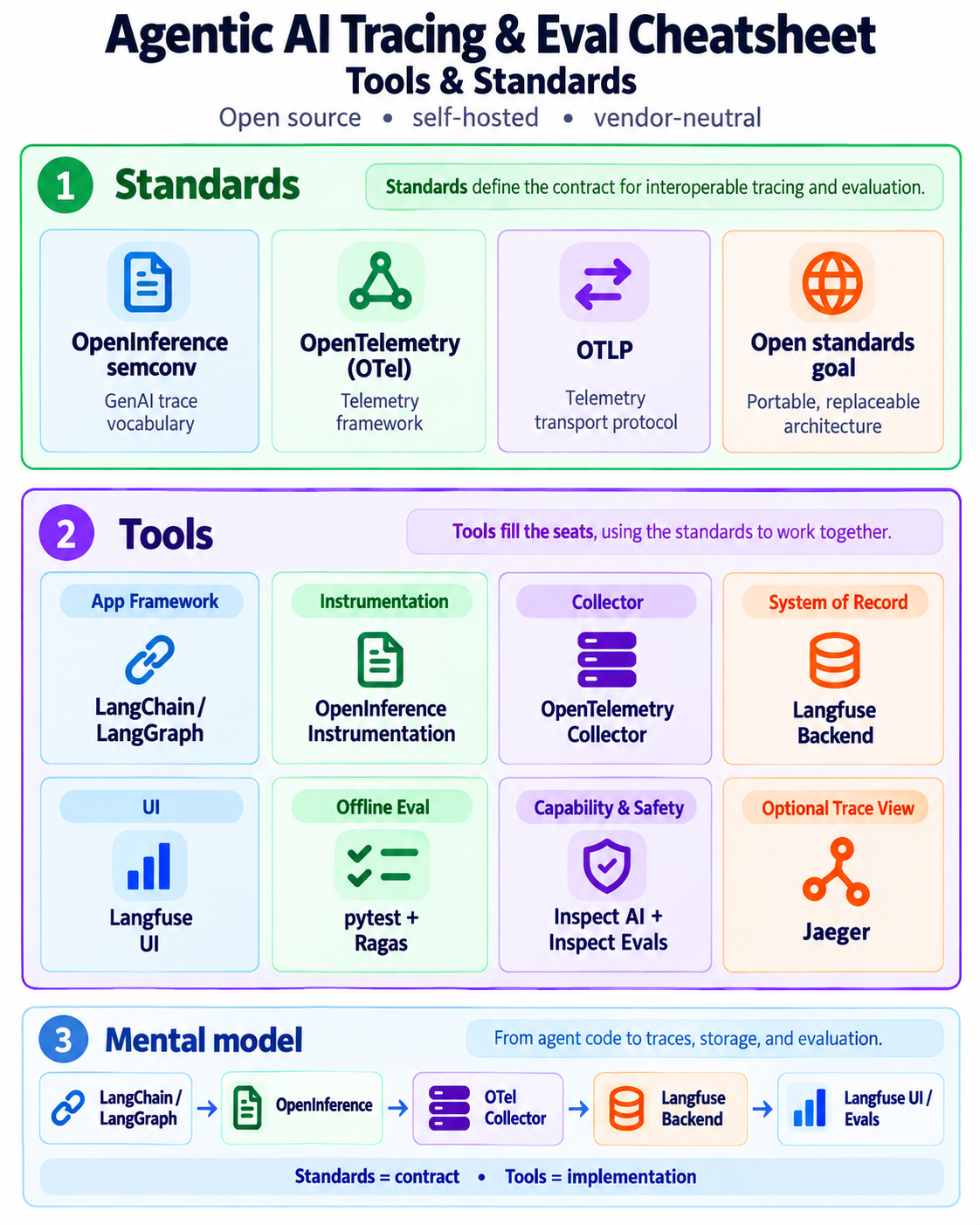


I’ve been thinking about agentic AI observability and evaluation less as a tooling problem and more as an architecture problem.
The question I care about is not:
It is:
How do I build a system where tracing, evaluation, production feedback, and regression testing reinforce each other without creating overlapping sources of truth?
That shift in framing changes the entire design.
Instead of searching for one tool that “does everything,” I want a stack in which every component has a clear responsibility, every layer is replaceable, and the system improves continuously from real usage.
The architecture I’ve converged on is a unified, completely open-source tracing and evaluation stack for agentic AI systems.
It is built around a few simple ideas:
This post explains the reasoning behind that architecture.
At a high level, the system looks like this:
Agentic application
→ OpenInference instrumentation
→ OpenTelemetry Collector
→ Langfuse Backend
→ Langfuse UI + evaluation loops
→ continuous improvement back into regression testing
The application layer can be built with LangChain / LangGraph and include:
The tracing layer is intentionally simple:
The evaluation layer is split into distinct modes:
pytestThese all feed results back into Langfuse and eventually into a continuous improvement loop:
Production → Trace → Evaluate → Score → Review → Dataset → Regression Test → Fix
That loop is the real heart of the system.
The first principle is that tracing should be part of the platform, not something every application developer has to think about while building business logic.
Agent developers should not have to care about a proprietary tracing backend every time they write:
They should write agentic code.
The system should take care of emitting structured telemetry through open standards.
That is why I prefer OpenInference instrumentation at the application layer.
It captures the semantics that matter in agentic systems:
And it emits telemetry in a form that remains compatible with the broader OpenTelemetry ecosystem.
That gives me a clean boundary:
Once that boundary is clean, the backend becomes replaceable.
That is a much healthier architectural position than coupling the application directly to an observability vendor.
The second principle is that the telemetry contract matters more than the specific backend.
That is why OpenTelemetry sits at the foundation.
I do not want application code hard-wired to one trace store. I want telemetry to move through a standard pipeline.
That is the role of the OpenTelemetry Collector.
The collector is not where agent semantics are created. It is where telemetry is governed.
Its responsibilities are operational:
This is a crucial layer because it centralizes policy.
Instead of implementing redaction, sampling, or routing separately in every service, the collector enforces those rules once.
This also keeps the architecture vendor-neutral.
If I want to send the same telemetry to Langfuse today and another OTLP backend tomorrow, I can do that without rewriting the application.
That portability is one of the biggest advantages of using open telemetry standards properly.
A platform becomes fragile when there are multiple competing sources of truth.
That is why I prefer Langfuse Backend as the single system of record.
I want one place to store and organize:
And I want the UI to sit on top of that same source of truth.
This is why I distinguish clearly between:
That distinction matters.
The backend is where structured evidence lives.
The UI is how engineers, reviewers, and evaluators interact with that evidence.
With that separation, the architecture stays conceptually clean:
That creates continuity across development, testing, and production.
This is one of the most important design choices in the architecture.
I want evaluation to be a consumer of trace evidence, not a second system creating its own competing representation of execution.
The trace already contains the facts I care about:
That is enough evidence for many forms of evaluation.
So the role of an evaluator is simple:
look at the trace, judge the behavior, and attach scores back to the same system of record.
I do not want:
That usually leads to duplication, ambiguity, and operational complexity.
The architecture is much cleaner when traces are the canonical execution record, and evaluations are annotations on top of that record.
Not all evaluation is the same.
That sounds obvious, but many teams still try to force very different testing problems into a single framework.
I think that is a mistake.
A pre-merge regression test is not the same as a sandboxed capability evaluation.
And neither is the same as continuously scoring production traffic.
These are different questions:
This asks:
This is where I want:
pytestThis asks:
This is where Inspect AI and Inspect Evals make sense.
This asks:
This is where I want:
I would rather use focused tools with clear responsibilities and connect them through shared data contracts than stretch one broad framework across all three modes.
Another core principle: use code when code is enough.
If I can validate something deterministically, I should do that before reaching for an LLM judge.
Examples include:
This gives me evaluation that is:
That is why in the regression layer I lean first on deterministic scorers and then use Ragas as the focused metric library.
I specifically like the discipline of using only Ragas for metrics rather than accumulating multiple overlapping scorer libraries. It reduces complexity and makes the evaluation layer easier to reason about.
LLM judges are still useful, but they should be used where judgment is genuinely required, not as the default answer to every evaluation problem.
This is probably the most important part of the architecture for me.
A bad production trace should not end as:
It should be:
That creates a real improvement loop.
Production teaches the test suite.
The test suite protects the next release.
This is where the value of unified tracing and evaluation becomes obvious.
A production trace is not just an operational artifact.
It is also a potential training example for engineering quality.
By storing trace evidence, review outcomes, scores, and datasets in one coherent system, you make learning from failures operationally practical.
That is what turns observability into improvement instead of just reporting.
For me, “completely open source” is not just about principle or cost.
It is an architectural property.
I want the freedom to change:
without rewriting the agent itself.
That only works when:
Open source gives me leverage because it keeps the architecture modular.
If a component underperforms, I can replace it.
If operational requirements change, I can reconfigure it.
If my team wants more control over telemetry or evaluation, we can make those changes without rebuilding the whole platform.
That is why the combination of:
matters so much.
The ecosystem has many strong eval frameworks.
That is not the problem.
The problem is what happens when too many of them occupy the same seat.
The question is not whether a framework is good.
The question is:
Does it own a responsibility that is not already covered?
If a new framework introduces another concept of:
without solving a genuinely new problem, I would rather not add it.
More tools do not automatically produce a better platform.
Clearer boundaries usually do.
That is why I prefer a stack where every component has exactly one reason to exist:
That is a coherent architecture.
It is easier to explain, easier to operate, and easier to evolve.
If I had to summarize the architecture in one line, it would be this:
The goal is not just to observe the agent.
The goal is to build a system that gets better because it is observable.
That is what the continuous improvement loop is doing:
Production → Trace → Evaluate → Score → Review → Dataset → Regression Test → Fix
That loop is the real product of the architecture.
Everything else exists to make that cycle reliable.
When the loop works:
That is the kind of AI engineering platform I would want a team to build on.
It is:
And most importantly, it aligns tracing and evaluation into one coherent engineering system instead of treating them as disconnected tool choices.
The architecture in the postx` is the result of this thinking:
That is the platform shape I find most compelling for agentic AI.
Not because it has the most tools.
But because it has the clearest contracts.