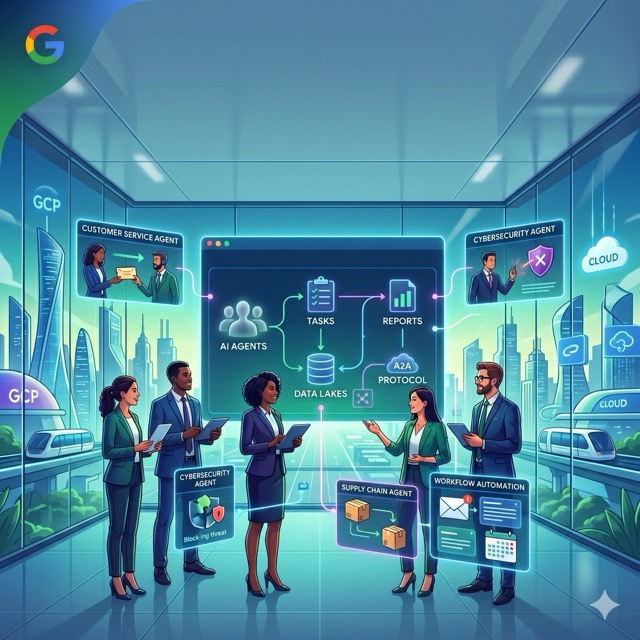
Google Cloud Next '26 (held April 22–24 in Las Vegas) signaled a massive shift from "Generative AI" to the "Agentic Enterprise." The overarching theme was moving beyond chatbots to autonomous agents that can execute complex workflows across entire organizations.
Here are the key takeaways and major announcements:
1. The Big Rebrand: From Vertex to Gemini
In a move to simplify its AI stack, Google rebranded its core AI platform:
- Gemini Enterprise Agent Platform: Formerly Vertex AI, this is now a unified hub for building, scaling, and governing AI agents.
- Workspace Studio: A new no-code agent builder that allows business users to create automations (e.g., "Summarize these emails every Friday") using plain natural language.
- Agent2Agent (A2A) Protocol: Now governed by the Linux Foundation, this protocol allows agents built on different platforms (Google, AWS, Salesforce, etc.) to communicate and hand off tasks to one another.
2. Infrastructure: 8th Gen TPUs and Axion
Google continues to double down on custom silicon to reduce costs and increase speed:
- 8th Generation TPUs: Announced with two variants—TPU 8t (for heavy-duty model training) and TPU 8i (optimized for low-latency, low-cost inference).
- Axion Processors: Google’s custom Arm-based CPUs are now generally available, claiming significantly better price-performance than standard x86 chips.
- Managed Lustre: A new storage solution providing a massive 10 TB/s throughput to feed data-hungry AI models.
3. Model Updates: Gemini 3.1 & Nano Banana 2
- Gemini 3.1 Pro: The latest flagship model, focusing on extreme context windows and lower "hallucination" rates for enterprise tasks.
- Nano Banana 2: A quirky-named but powerful new image generation model designed for high-speed, high-fidelity creative workflows.
- Project Mariner: A "web-browsing agent" that can navigate the live internet to perform research and fill out forms on behalf of users.
4. Data & Security: The "Agentic Data Cloud"
To support agents, Google updated the "pipes" that move data:
- Agentic Data Cloud: Includes a cross-cloud Lakehouse that lets agents access data across GCP, AWS, and Azure without moving the files.
- Agentic Defense: A partnership with Wiz to create "Threat Hunting Agents" that proactively search for vulnerabilities and "Detection Engineering Agents" that write security rules automatically.
- AI Overviews in Gmail: A rollout of the search-style "AI Overview" directly into Gmail to summarize long threads and find specific data (like flight confirmation numbers) instantly.
5. Massive Investment & Partnerships
- $750 Million Partner Fund: Google is putting significant capital into its partner network (Deloitte, Accenture, etc.) to help enterprises deploy agents.
- Salesforce & SAP Integration: Deep "multi-agent" pacts were announced where Salesforce’s agents and SAP’s "Joule" can work natively within the Gemini ecosystem.
The Bottom Line: Google is betting that 2026 is the year AI stops being a "feature" and starts being a "workforce." The focus has moved entirely toward Agents that have memory, can use tools, and can talk to other companies' AI.

.png)
.png)
.png)

.png)



.svg)